Open source · Local-first · Git-native

Your agents can write code. AIOS makes them earn the merge.

Run Claude Code and Codex as a real engineering system—independent review, isolated worktrees, verification before approval, and a complete evidence trail after every run.

npm install -g @devin-lai/aios

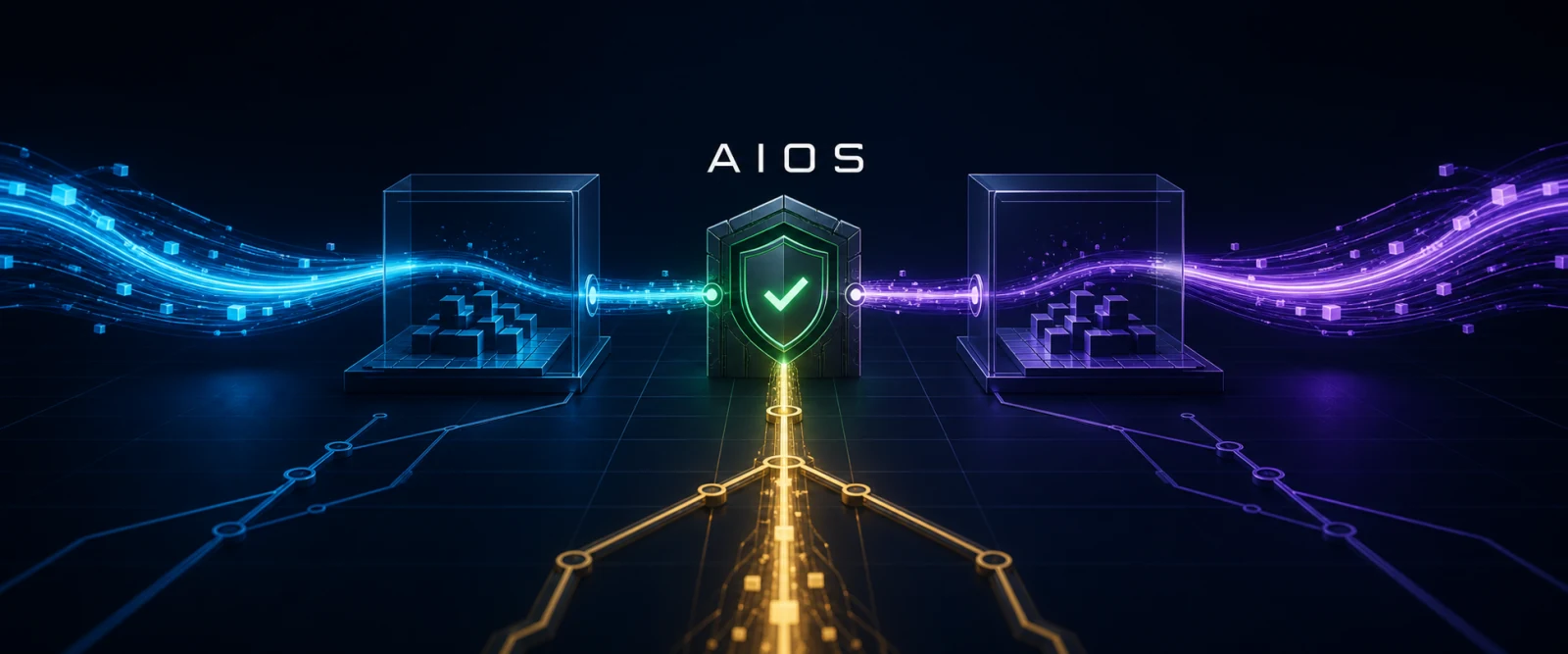
Two independent coding-agent streams pass through isolated workspaces and meet at a green verification gate

Why AIOS

A diff is not the finish line.

Most agent workflows optimize for producing code. AIOS optimizes for producing code with enough evidence to trust.

One-agent loop Fast output. Weak separation.
AIOS An engineering system around the agents.
01

The author reviews its own work.

A different engine must review every change.

02

Parallel edits share mutable state.

Every task gets a dedicated branch and worktree.

03

Tests are an optional follow-up.

Verification failures are blocking review issues.

04

Failures disappear into chat history.

Prompts, responses, checks, and verdicts stay on disk.

The system

One prompt. Six enforced gates.

AIOS turns agent work into a bounded, inspectable delivery pipeline. Every transition has a reason, an artifact, and a failure state.

  1. 01

    Spec twice

    Claude and Codex draft independently, then merge, polish, and critique the plan.

    output / project.md
  2. 02

    Build the DAG

    The specification becomes dependency-aware tasks with explicit acceptance criteria.

    output / tasks/*.md
  3. 03

    Isolate the work

    Each task runs on its own branch in its own worktree. Your checkout stays yours.

    state / aios/task/<id>
  4. 04

    Verify, then review

    Tests, lint, type checks, and builds become evidence for an independent reviewer.

    gate / all green
  5. 05

    Invalidate stale proof

    After rebase, AIOS runs review and verification again against the actual merged tree.

    gate / re-review
  6. 06

    Merge only on green

    The staging branch becomes a pull request, waits for CI, and squash-merges on success.

    result / main

Evidence, not vibes

See exactly what happened.

A run is not a disappearing conversation. AIOS writes the full chain of evidence locally so failures can be diagnosed without rerunning the agents.

  • Exact prompts and raw responses
  • Retry attempts and token use
  • Verification output and reviewer verdicts
  • Structured failure and handoff reasons
aios — zsh local
$ aios ship "Add request IDs with tests"

 spec synthesized          18.4s
 4 tasks scheduled         parallel: 3
 test · lint · build        all green
 independent review         approved
 post-rebase gates          green
 merged PR #42              main

Built to stop safely

Autonomy with edges.

AIOS spends its complexity on the places where unattended coding usually fails: isolation, cancellation, stale evidence, secrets, and loops that should have stopped.

Independent review

The builder cannot approve itself.

Configuration and runtime selection both reject identical coder and reviewer engines. The separation is a program invariant, not a prompt suggestion.

coder_default != reviewer_default enforced

Isolation

Your checkout stays untouched.

Task work and merge integration happen in dedicated worktrees.

Bounded recovery

Stuck work has a ladder—and an end.

Retry, revise, decompose, respec, then structured human handoff.

Scoped tools

MCP access starts at deny.

Tasks opt into named servers; retained configuration is redacted.

Cost visibility

Token usage stays attributable.

Inspect per-run estimates and recurring review patterns locally.
Start in three commands

Put a reviewer between your agents and main.

AIOS ships as a native binary through npm. You need Git 2.40+ and authenticated Claude Code and Codex CLIs. GitHub CLI is required for the pull-request flow.

01 npm i -g @anthropic-ai/claude-code @openai/codex
02 npm i -g @devin-lai/aios
03 aios init && aios doctor && aios

Open source under MIT

Code quickly. Merge deliberately.

Keep the agents you already use. Add the separation, verification, and evidence that autonomous work needs.